Many adults carry a quiet, persistent feeling that something about them is fundamentally off.
Some feel like they are too much—too emotional, too sensitive, too needy, too intense. Others feel chronically not enough—not interesting enough, not capable enough, not lovable enough. And some move back and forth between the two, depending on the situation or relationship.
These beliefs often show up in subtle ways. You might hesitate before sharing how you really feel. You might over-apologize, over-function, or minimize your needs. Or you might pull away entirely, convinced that closeness will only confirm what you already fear.
If any of this feels familiar, you’re not alone. And these beliefs rarely come from nowhere.
These Feelings Aren’t Random
Feeling “too much” or “not enough” isn’t usually a personality flaw or a sign that something is wrong with you. More often, these beliefs are shaped over time through relationships—especially early ones.
Children naturally look to caregivers to understand who they are and what is acceptable. When emotional needs are met with consistency, curiosity, and care, children tend to internalize a sense of worth and belonging.
When needs are misunderstood, minimized, or met inconsistently, children don’t stop having needs—they start making meaning about themselves.
That meaning can quietly follow them into adulthood.
How Early Relationships Shape Self-Worth
Early relational experiences teach us powerful lessons, often without words.
A child who is told—directly or indirectly—that they’re too sensitive may learn to suppress emotions. A child whose needs are overlooked may learn not to ask. A child who receives attention primarily when performing or pleasing others may learn that love is conditional.
Over time, these experiences can solidify into internal beliefs such as:
- “My emotions are a burden.”
- “I have to earn connection.”
- “If I show my real self, I’ll be rejected.”
- “Something about me is fundamentally lacking.”
These beliefs are not conscious choices. They’re adaptations—ways of staying connected or safe in the environments we grew up in.
Exploring these patterns is often part of work in self-awareness therapy, where the goal is not self-criticism, but understanding.
Feeling “Too Much”
People who feel “too much” often learned early that their emotions were overwhelming to others.
They may have been:
- Told to calm down, toughen up, or stop reacting
- Met with discomfort when expressing sadness, anger, or fear
- Praised for being “easy” when they stayed quiet or self-contained
As adults, they may:
- Second-guess their feelings
- Hold back from sharing needs
- Worry about overwhelming others
- Apologize for emotional responses
This can create a painful tension—wanting closeness, but fearing that closeness will cost too much.
Feeling “Not Enough”
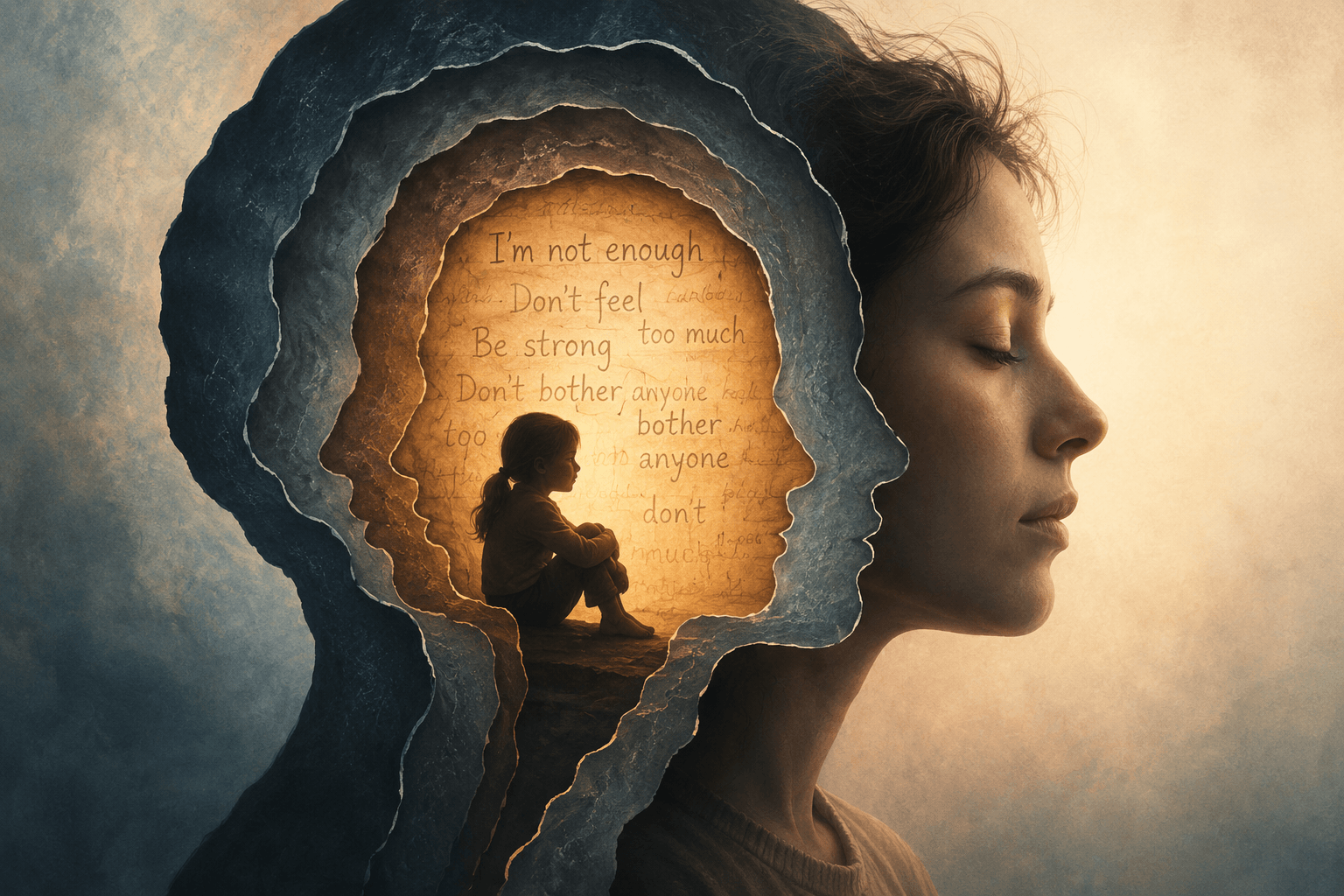
Others carry a belief that they are somehow lacking.
This can develop when:
- Attention or affection felt inconsistent
- Caregivers were emotionally unavailable or preoccupied
- Love felt tied to achievement, behavior, or performance
Adults with this belief may:
- Strive constantly to prove their worth
- Compare themselves to others
- Feel unseen even in relationships
- Assume rejection is inevitable
Even success or reassurance may not fully land, because the belief runs deeper than logic.
Why These Beliefs Stick Around
Once formed, beliefs about being “too much” or “not enough” tend to reinforce themselves.
The nervous system becomes alert for evidence that confirms the story:
- A delayed text becomes proof of being too needy
- A neutral comment feels like criticism
- Distance is interpreted as rejection
This is not because the belief is true—but because the system learned early to watch for threat.
Patterns like this often show up in close relationships and can intersect with dynamics explored in the blog on the pursue–withdraw pattern, where one person seeks reassurance while the other pulls back.
The Role of Emotional Avoidance
Many people cope with these beliefs by avoiding emotions altogether.
If feelings once led to shame, conflict, or disconnection, avoiding them can feel safer. Over time, this avoidance can create numbness or distance from oneself and others.
This pattern is explored more deeply in the blog on emotional avoidance, which looks at how staying disconnected from feelings can quietly shape stress and relationships.
Avoidance may protect in the short term, but it also prevents healing.
Why Insight Alone Doesn’t Undo These Beliefs
Many adults can clearly identify where their beliefs came from—and still feel stuck.
That’s because these beliefs aren’t just thoughts. They’re held in the nervous system, shaped through repeated relational experiences.
Understanding matters, but healing often requires:
- Emotional safety
- New relational experiences
- Being seen and responded to differently over time
This is where therapy can be especially supportive.
How Therapy Helps Shift These Patterns

In individual therapy, people are invited to explore these beliefs with curiosity rather than judgment.
Therapy offers a space to:
- Notice when “too much” or “not enough” shows up
- Explore where the belief came from
- Experience being emotionally received without having to perform
- Practice expressing needs and feelings safely
Over time, new experiences begin to reshape old beliefs—not through force, but through consistency and care.
Some people also find that these beliefs intersect with broader life experiences, including faith transitions or identity shifts. In those cases, work like therapy for religious trauma may overlap with attachment and self-worth healing.
Moving Toward Self-Compassion
Healing doesn’t mean erasing every self-doubt or never feeling triggered again. It means developing a kinder, more flexible relationship with yourself.
Self-compassion grows when you can say:
- “This belief makes sense given what I experienced.”
- “I’m not broken—I adapted.”
- “I can learn new ways of relating now.”
These shifts often happen gradually, in relationship.
You’re Not Too Much. You’re Not Not Enough.
The belief that you are “too much” or “not enough” is not a truth—it’s a story that formed in response to real experiences.
With support, that story can soften.
If you’re curious about exploring these patterns with a therapist or counselor in Castle Rock, you can learn more about available services at Revive Relational Therapy or take a gentle next step to book a session here when the time feels right.
You don’t have to carry these beliefs alone—and you don’t have to rush the process of understanding them.